Back to Contents
Back to Railways Page
Link to Sitemap
30458
‘Ironside’
Ironside was one of a pair of saddle tanks provided by Hawthorn, Leslie and Co. to Southampton Dock Company in 1890 (the other was ‘Clausentum’). When the Southampton Dock Company was taken over by its major shareholder, the London South Western Railway, in 1892 these two locos formed part of the stock subsumed.
After seeing service under the LSWR and Southern Railway our story resumes with Ironside, by now classified 0458 and numbered 30458, working as Guilford shed pilot under British Railways. She survived there until 1954.
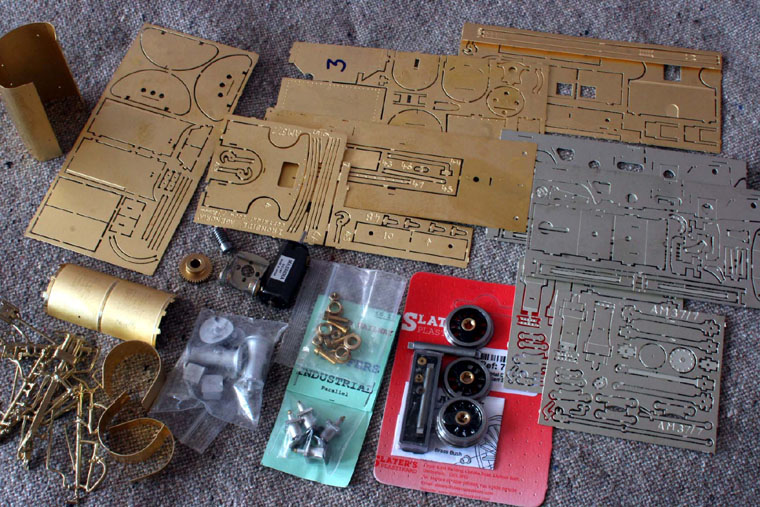
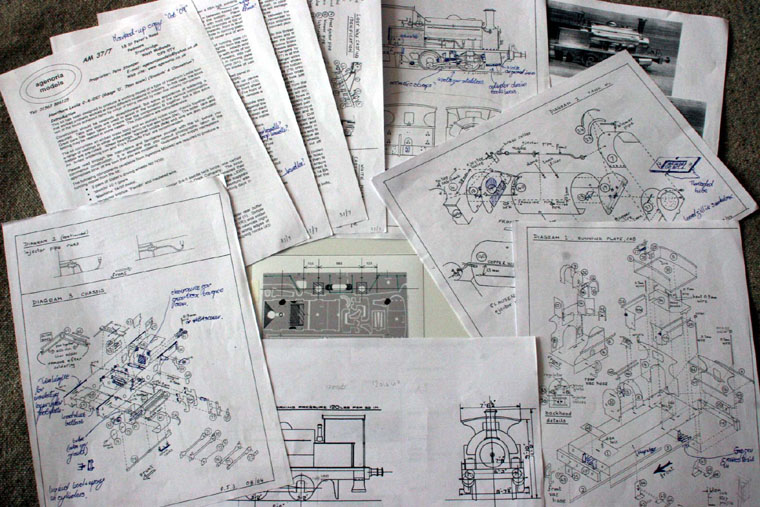
The model is based upon the well-reviewed Agenoria kit for Ironside and Clausentum (item AM37/7). There are (inevitably!) some changes I want to make to the build to give the best operation and performance for a working model. I also wished to see if there were any details that I wanted to improve:
- Equalised chassis – All-wheels in contact with the track on 0-4-0 locos is a must for both haulage and pick-up.
- Split axles – Low friction, high reliability pick-up.
- DCC – Now the standard for my models, with good decoders this gives a significant advantage in performance over analogue control.
- Sound – An emerging standard for the 0-gauge models I’m currently building.
This leads to a number of technical issues to solve:
- Compensation / springing / hybrid chassis set-up.
- Split axles / frames / how to apply insulation (relates to chassis set-up, above, as well).
- Electrically splitting the gearbox and potentially how to suspend it in the frames.
- Where to put the decoder?
- Where to put the sound chamber?
- Where to put any weight?
I decided to wait until I had the kit parts in my hands before looking too hard for any solutions. Though I did have some fun looking to see what may be useful. What follows is a description of how the solutions were applied to the model, rather than a blow-by-blow account of what I did:
Equalisation
I like the idea of using conventional compensation as it allows you to control where and how the weight is applied through the chassis. The problem with an 0-4-0 is that it would ‘settle’ on rough track or across point vees resulting an a jerky or bumpy appearance when running.
Springing isn’t without its problems either – particularly with small wheelbases, though the use of Slater’s hornblocks with insulated guides (item 7960) does make it attractive both from the point of running performance and the use of split-axle pick ups.
There is a compromise position, that may well give the best of both worlds. These are called Continuous Springy Beams (CSB) about which there is loads of info on http://www.clag.org.uk/beam-annex3.html. With other locos in mind where CSBs may be useful as a way of providing clear spaces in a chassis I decided that this loco would be a suitable trial, as well as (hopefully!) giving good running performance.
Split axles / frames
With CSBs decided upon it then became necessary to look for methods of applying the technique, as well as allowing for our simple approach to split axles. There seemed to be two possible methods for achieving this:
- Normal, metal, hornblocks/guides and splitting the frames and axles.
- Insulated hornblocks/guides and splitting only the axles.
In the end I decided to use a set of Martin Finney GWR hornblocks (item HB7/2). They’re simple in outline, nicely detailed and I had them in stock. I did make a passing nod in the direction of the Slater’s insulated hornblocks (item 7961), with the intention of using something like 2mm ‘L’ angle to make up the guides – they remain a possible solution.
Gearbox
If the loco was going to have split axles then a way to split the gearbox would have to be found. Thankfully the recommended drive is one I’m familiar with from my 4mm scale modelling days; Markits 40:1 gears and a Mashima 1430 in an etched frame. Never a favourite back then, I did look to see if an ABC would fit. It doesn’t, which in some ways makes life a bit easier…
With an etched frame it’s fairly easy to insulate using copper-clad paxolin, providing a sensible way of electrically breaking the axle can be established. There are some potential solutions and the example from this loco in the tips and tricks area of this website, which I hope is useful.
Where to put the…
The problems with the installation of a DCC decoder, sound chamber and the necessary ballast weights are obviously linked; they're associated with the free volume in the model. Thankfully there’s a fairly straightforward way of getting it all in there. The first thing to consider is that although this may be a small loco by 0-gauge standards, it’s HUGE if you’re used to 4mm or H0 scale. So I am pretty confident that the space for all the gubbins genuinely exists in the model.
First off the weight. It needs to be distributed to balance around the centre of the driving wheelbase and it helps if it’s as low down as possible. So the plan is to fill the bufferbeams, cylinders, valve chest and any clear volume around the firebox and ashpan with lead. I’ve got a set of whitemetal loco crew figures. The smokebox and coal bunkers can be lead filled if necessary. I’ve also had good experiences in making sound chambers from lead and will probably do the same in this loco.
Fitting the DCC decoder and sound chamber. Even with the weight in place as described above, the boiler and saddletank remain empty. The current thought is to modify the saddletank into a sound chamber by putting a baffle (in lead) across its base, with a cut-out for a 20x40mm speaker. The sound would then channel out through the firebox. The decoder can then fit under the speaker, in the boiler, and will probably have to be hard-wired into the chassis.
Well, that’s the theory. The hard bit will be working out how to split (and retain) the saddletank on the rest of the body.
Details
The kit looks to be a very simple, elegant piece of design. For a model of Ironside as running in the late 1940s and early 1950s there were some details and additional parts I decided to purchase to finish the model. Some of these are additions; some are used because they're improvements over the parts provided:
- Completion Pack (wheels/motor/gears/etc.) from Agenoria.
- Name-, number- and shed-plates from Guilplates.
- Crew – 2 figures, items R3, R4, from Heroes of the Footplate.
- Couplings – ‘Wagon 3-link type’ , item 36, from CPL.
- Buffers – MR type (for the back), LSWR type (for the front), items 7900 and 7910, from Slater’s.
- Lamp Irons – LSWR type (1 set item 17-19), SR type (2 sets item 17-17) from Laurie Griffin.
- Smokebox door handles – item 7M637, from Alan Gibson.
- Cab gauges – item 7I030, from Hobbyhorse.
- Ashford pattern injectors - item 15-19 or 15-27 from Laurie Griffin (mine actually came out of my bits box).
- Crankpin parts – My current arrangment uses 10BA steel screws and washers. Bushes come from Slater’s or Alan Gibson and I tap them 10BA, CPL item 93 or 94 crankpin nuts. (So if you like this idea you’ll also need a 10BA taper tap – ideally HSS for tapping the steel bushes provided by Alan Gibson).
- Hornblocks/guides – ‘GWR style’ item, HB7/2, from Martin Finney.
- DCC +sound decoder – ESU LokSoundv3.5 from South West Digital. (I’ll be programming this myself using the ESU LokProgrammer).
- Speaker – ESU 40x20mm from South West Digital.
- 4mm scale crankpins (to retain crosshead and connecting rod) - item 4M42, from Alan Gibson.
- Liquid lead – from Eileen’s Emporium.
- Lead sheet ‘flashing’ – from your local hardware/roofing supplies.
- Handrail knobs (for CSBs); short, medium, long – from Alan Gibson/Slater’s.
- Spring steel ‘piano’ wire; 22swg, 24swg (for CSBs) – from your local (radio control) model shop.
- Sundries; copper clad paxolin sheets, brass wire, rod, tube, sections, screws, etc. – from various sources including Eileen’s Emporium.